I’ve learned and reflected on so much history of the Vietnam war that The Things They Carried had a profound effect on me. It immediately had me immersed in the setting, the characters, and their stories. However, there is a lesson in these sentences that brought me back to the story, which led me to reflect on the entire period of time (the timeline of the war) again. I found these sentences to be strong tellers of what the story was about, but also carriers of something new to learn in their individuality.<br> Throughout the story, Tim O’Brien details what the group of soldiers carries. Every item had a deeper effect on each character and a back-story. Some tangible, and others intangible. However, the group lacked something they carried that brought them together, until this sentence; “They carried all they could bear, and then some, including a silent awe for the terrible power of the things they carried”. First, the sentence highlights how the characters had to over-exert themselves in order to survive and live through difficult events. They carried “all they could bear”, telling readers of their strenuous journeys, “and then some” only indicating their struggles further. For example, following the death of Ted Lavender, not only did they have to deal with the death of a comrade but also what he had carried, his tranquilizers and so forth. In that sense “and then some” could not only be meant to extend the weight of their struggles but how the weight of what they carry accumulates. It would have made sense to leave “and then some” out, but I interpret it as an intentional bridge to see that the characters had carried a bit off one another, amounting to an incredibly heart-rending ethos.<br> The next part of the sentence shows that the is group aware of how each of them carries a heavy, intangible weight. In addition, the phrase provokes me to think about the soldiers’ past actions, and how their futures have been permanently altered. For example, the word choice of a “silent awe” leads me to believe that their understanding and interpretations of all that they have carried is mutual. As the characters become numb, some more than others, they are connected in that common understanding. The life-changing realization that they are alone in this conflict between peoples, seems more tangible when they see others in the same position. Everyone seeks a further understanding of “things” and the group found that in themselves and each other. <br> Finally, the “terrible power” of what they carried seems to be a show of the way war can change a soldier’s mind. I can’t help but think about Norman Bowker’s thumb that he carries; such a bizarre and gruesome tangible to carry, but it meant something to him. “Terrible” in this setting gives me a feeling of “something bad has happened, what now?”. That said, this sentence is a strong example of the hardships the characters when through, but also provides readers a complex foundation to interpret the soldiers’ experiences. <br>
Saturday, April 11, 2020
The Things They Carried: Intangibles
I’ve learned and reflected on so much history of the Vietnam war that The Things They Carried had a profound effect on me. It immediately had me immersed in the setting, the characters, and their stories. However, there is a lesson in these sentences that brought me back to the story, which led me to reflect on the entire period of time (the timeline of the war) again. I found these sentences to be strong tellers of what the story was about, but also carriers of something new to learn in their individuality.<br> Throughout the story, Tim O’Brien details what the group of soldiers carries. Every item had a deeper effect on each character and a back-story. Some tangible, and others intangible. However, the group lacked something they carried that brought them together, until this sentence; “They carried all they could bear, and then some, including a silent awe for the terrible power of the things they carried”. First, the sentence highlights how the characters had to over-exert themselves in order to survive and live through difficult events. They carried “all they could bear”, telling readers of their strenuous journeys, “and then some” only indicating their struggles further. For example, following the death of Ted Lavender, not only did they have to deal with the death of a comrade but also what he had carried, his tranquilizers and so forth. In that sense “and then some” could not only be meant to extend the weight of their struggles but how the weight of what they carry accumulates. It would have made sense to leave “and then some” out, but I interpret it as an intentional bridge to see that the characters had carried a bit off one another, amounting to an incredibly heart-rending ethos.<br> The next part of the sentence shows that the is group aware of how each of them carries a heavy, intangible weight. In addition, the phrase provokes me to think about the soldiers’ past actions, and how their futures have been permanently altered. For example, the word choice of a “silent awe” leads me to believe that their understanding and interpretations of all that they have carried is mutual. As the characters become numb, some more than others, they are connected in that common understanding. The life-changing realization that they are alone in this conflict between peoples, seems more tangible when they see others in the same position. Everyone seeks a further understanding of “things” and the group found that in themselves and each other. <br> Finally, the “terrible power” of what they carried seems to be a show of the way war can change a soldier’s mind. I can’t help but think about Norman Bowker’s thumb that he carries; such a bizarre and gruesome tangible to carry, but it meant something to him. “Terrible” in this setting gives me a feeling of “something bad has happened, what now?”. That said, this sentence is a strong example of the hardships the characters when through, but also provides readers a complex foundation to interpret the soldiers’ experiences. <br>

Has Vashti’s Love for Kuno Been Erased?
The Machine Stops represents the doubt and wonder surrounding the rapid development of technology. However, E.M. Forster’s story also showcases a narrative of love, one that is transformed as Kuno lets his curiosity lead his actions. Kuno was driven to such a point that he went against everything and everyone around him, yet his mother was willing to discuss his views with him. However, the Machine contaminated their relationship in the end, as Vashti became too distant to ever regain the love she once had for Kuno. Vashti’s submission to the Machine had taken her over.<br>It began when Vashti accepted the flaws that the Machine had torn into human civilization. When Kuno tells her of an idea he had for life above the surface, Vashti notices he becomes silent and possibly unhappy, but she couldn’t be sure because of the rough projection the Machine created of Kuno. Expressions are key for people to understand each other, to empathize, but Vashti seems comfortable to dismiss this practice. She tells herself, “the imponderable bloom, declared by a discredited philosophy to be the actual essence of intercourse, was rightly ignored by the Machine...Something “good enough” had long since been accepted by our race”. Vashti’s sense of “good enough” hints at her acceptance of not only the state in which she lives but the position humanity has been put subject to. This fundamental disagreement between Vashti and Kuno is the first step to pulling them apart.<br>While this disagreement drives them apart, it isn’t enough to visibly impact Vashti’s and Kuno’s relationship. While their disagreements are inherent, Vashti isn’t acting against her son. Then came the point in the story that Kuno had extensively explored the surface, and reflected on his ideas. In a turn of emotion, Vashti directly showed her disapproval for Kuno’s actions. Vashti tells him “Don’t. Don’t talk of these terrible things. You make me miserable. You are throwing 12 civilization away”. Here, Vashti accuses Kuno of sullying the life the Machine has brought her, and so many others. It is no longer a difference of views, but a betrayal. You, Kuno, are “throwing civilization away”. In a sense, Vashti struggles to accept that Kuno became so much so that she makes him the enemy. <br>The accumulation of such things leads me to believe Vashti has settled for a connection that is less than love. Repeatedly, Vashti shows affection for her son, sympathy, but it is swiftly cut with the interjections of the cold machine. This was a short story showcasing the fear of developing technology, its frightening power to create but to also divide. The constant pressure exerted on Vashti by the machine, and her dependence on it has arguably cost her her love for Kuno.
Thursday, October 24, 2019
A Peaceful Place

 There are few places I can say invoked peaceful feelings in me. It isn’t that I can’t find these places, but more that there is a certain connection in finding peace between you and a place. From what I’ve noticed, relaxing in a nice place, or reading a book by a river, for example, isn’t true peace. I take true peace as a disconnection from the conflict and constant flow of life and leaving them behind. If I can find a place, and truly forget about conflicts back in my day-to-day life, I think I’ve found peace for a while.
Of course, making that next step is difficult, because it takes self-initiative. It's also up to personal character of what kind of places you like. For me, this place is Lake Berryessa. Its located in Napa County, California, which is about an hour and a half away from where I used to live. Its known for the “Morning Glory Spillway”; a drainage system that appears like a black-hole, in water. The spillway is right next to the Monticello Dam, which was built in 1957.
About twice a year my family would go to Lake Berryessa to hike one of the toughest trails along the mountain and its ridge. Its provided me with some pretty but also frightening memories. For example, when you take the long route for the hike we’ve done, there's a point where you have to lean against the mountain with a path, overlooking a steep fall. Hiking would usually take the whole day, with several milestones that I remember to this day. One was an abandoned stone house, in a clearing full of autumn leaves and right next to a blue flowing river. Not one patch of dirt could be seen on the floor, because of the coat of leaves everywhere. We tended to stay here and rest.
I think of this lake as my most peaceful place because of one particular experience. One weekend, my dad, my brothers, and I stayed there overnight. My dad had a friend who owned a research post in the mountain, and we got to camp out in the usually restricted area. We even got his Gator (or small all-terrain car). It's hard to come up with memories that made me feel the same way I did then. We spent the day hiking in new areas, and I would sit in the back of the Gator while my dad drove us over and up mountain ridges. The wind blew all around me, and at points it felt like I was touching the sky. Ultimately, every minute was fun or awe-inspiring, which led to an incredible immersion that disconnected me from my regular life for a while. Therefore, I find this a peaceful place.
Friday, September 6, 2019
A Day in Osteburken
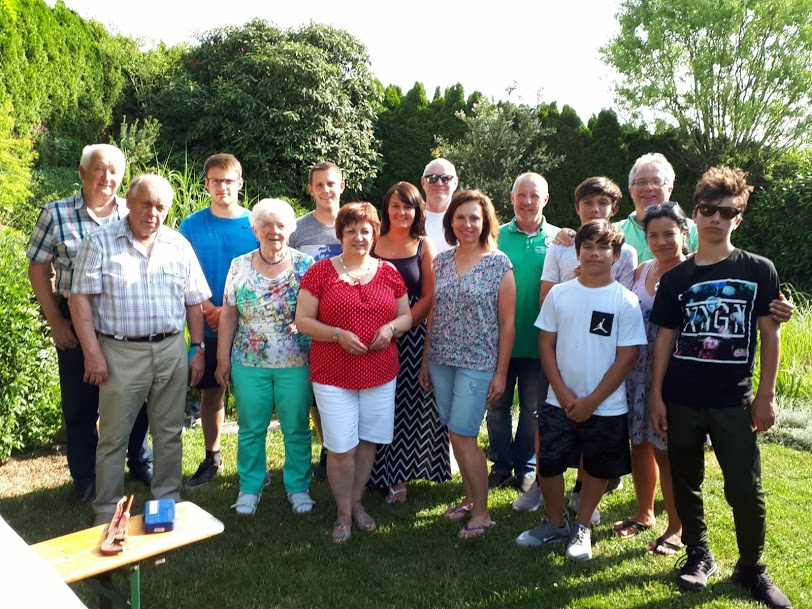 In the Summer of 2018, my family took a trip to Germany to visit my father’s parents and our cousins. We left for about a month and traveled from Southwestern Germany to Northern Italy. The picture above was taken in Osterburken, Baden-Wuttenberg. Baden-Wattenburg is one of the 15 states in Germany and is known to be the largest. My father’s cousin, Ditma, had a place there, with a large house and several warehouses. He started a business for home maintenance and basic repairs in the early 90s, and since then has been very successful. He is wearing a bright green shirt, next to my father, who also has a green shirt and glasses on.
It was pretty fascinating to be up close with Ditma’s business, and his sons who both held important positions as well. His sons are pictured behind the lady with a red shirt, Ditma’s mother. On the left, with a blue shirt, is Michael. On the right is Phillip, who is currently racing Go-Kart among the best in Germany. His girlfriend, Emily, is standing in front of him with a blue and white dress. She places even better in national Go-Kart racing, where she has placed top 5 in all of Germany. My brothers and I got the chance to race them, but it was over in a matter of moments.
What made the trip to Osterburken special was seeing the change that had taken place there. We had gone there once before in 2010. Back then, my brothers and I would be driven in tiny wagons by Phillip in his tractor. We tried badminton and rolled up and down the hill near their house. We hiked in forests, and never stepped inside until it was pitch black out. I would pick berries deep in the forest and collect them for a cake and put snails on any wall I could see. At the end of the day, we would eat the cake, baked by my grandfather who has been a baker since he moved out at 13. I also remember looking up to Michael and Phillip, who were both starting high school at the time.
It was because of these drastic changes that I was able to reflect on myself. Seeing Phillip and Michael grow into hard-working students and help their father in their family business made me ask myself what I wanted to pursue in the future. It was ultimately the first time I had deeply considered what I wanted to do, and it troubled me at first. Ditma holds very high expectations for his sons, and so does my father for me. That said, I really enjoyed our day at Osterburken not only because of family but also because it offered a new perspective on my own future.
Subscribe to:
Posts (Atom)